How we change what others think, feel, believe and do
|
|
How we change what others think, feel, believe and do |
Selecting the best course of action
Explanations > The SIFT Model > Selecting the best course of action Criteria | Negative selection | Forecasting and risk analysis | Positive selection
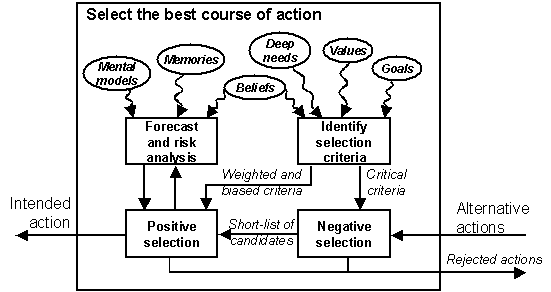
Given the possible courses of action, we now need to decide which will be carried forward for action. Creativity is often thought of as the divergent activity of coming up with good ideas, but equally important is converging back in as we select the ideas that will be used.
CriteriaSelection is done through the application of some form of criteria, which may be consciously or subconsciously selected. These are reasons for or against taking the action, which will allow us to weigh up the pros and cons or the return on investment for each alternative. Negative criteria, which give reasons not to select an alternative, may include costs, risks, difficulty, hassle and trouble. Positive criteria, which highlight the benefits that an alternative might offer, include whether goals will be met, how well they might be met, plus ease and speed of implementation. We tend to use many criteria based on deep needs and personality factors, for example extraverts may seek attention and risk whilst introverts will seek safety. Our values also lend key criteria that will help us decide what is right and wrong. Criteria may also be prioritized, for example cost may be all-important whilst time is a more negotiable element. Although we do not do mathematical weighting in our heads, we will usually lean towards some criteria rather than others. Negative selectionRemember when you last bought or rented a home. What you probably did was to go along to a number of housing agents and come away with piles of home details, then start your selection by sorting out the definite ‘no good,’ the ‘maybe’ and the ‘interesting’ homes. The initial strategy that we commonly use when faced with a lot of choices is to ‘sort the wheat from the chaff,’ rapidly eliminating those items we do not want, rather than looking closely at those which we might select. The negative criteria that we use clearly define the boundary of the problem in terms of our primary constraints. We reject houses because we definitely do not want to live in that area or cannot afford that amount of money. Forecasting and risk analysisA key technique for selecting the best course of action is to project the alternatives we are considering into the future to see what might happen if we implement each of these ideas. In forecasting we make much use of our mental models to help us grope forwards, weighing up the implications of each alternative, estimating both the possible outcomes and how likely each one is. We can then choose the most desirable future that will best move us towards achieving our goals. It is a testament to the power of human mind that we do this complex projection in the twinkling of an eye, whilst it still takes supercomputers many hours to calculate the weather. Positive selectionThe final selection of the alternative that we will implement uses criteria in a more positive way, seeking to narrow down the short-list to the item we will actually implement. This process is not always cool and rational, and even after a long and drawn-out selection process, we sometimes change our minds for no apparent purpose, probably because our subconscious either objects in some way to the selection or prefers another idea that has already been logically eliminated.
|
Site Menu |
|
| Home | Top | Quick Links | Settings | |
|
Main sections: | Disciplines | Techniques | Principles | Explanations | Theories | |
|
Other sections: | Blog! | Quotes | Guest articles | Analysis | Books | Help | |
|
More pages: | Contact | Caveat | About | Students | Webmasters | Awards | Guestbook | Feedback | Sitemap | Changes | |
|
Settings: | Computer layout | Mobile layout | Small font | Medium font | Large font | Translate | |
You can buy books here |
|
And the big |
|
| Home | Top | Menu | Quick Links | |
|
|
Site Menu |
|
| Home | Top | Quick Links | Settings | |
|
Main sections: | Disciplines | Techniques | Principles | Explanations | Theories | |
|
Other sections: | Blog! | Quotes | Guest articles | Analysis | Books | Help | |
|
More pages: | Contact | Caveat | About | Students | Webmasters | Awards | Guestbook | Feedback | Sitemap | Changes | |
|
Settings: | Computer layout | Mobile layout | Small font | Medium font | Large font | Translate | |
|
| Home | Top | Menu | Quick Links | |
|
|