How we change what others think, feel, believe and do
|
|
How we change what others think, feel, believe and do |
Regularity
Explanations > Perception > Regularity Description | Example | Discussion | So what?
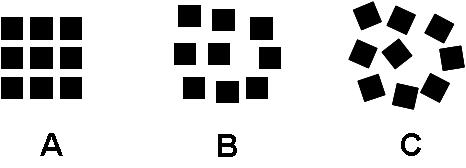
DescriptionWhen distinguishing individual items, we will sometimes cluster multiple shapes to form a larger object. In doing this, we will be more likely to connect items which form a regular pattern than those which are more randomly arranged. ExampleIn the diagram below, A is most easily seen as a single item as it has the same sub-shapes (black squares) and is arranged in regular rows and columns. B still has black squares, but the rows and columns are less organized. Even though C has black squares and may be seen as connected, they are now rotated and dispersed, breaking up the pattern even further.
DiscussionWe tend to use similarity as a rule for connecting things together. Those which are ordered are following similar shape, color and organizational rules and hence may be perceived as being related. When the order breaks up, item similarity may still lead to them being associated (as in the example above), but the connection is now not as strong as when they are ordered in the same way. Subjectively, order and disorder can have different aesthetic effects. Whilst order is comforting, it may also be boring. And whilst disorder can be confusing, the search for order can be interesting and the discovery of order pleasurable. A 'nice' picture or diagram hence has some disorder. The best balance of order and disorder may depend on the audience: sophisticated viewers can often handle and so prefer greater disorder, whilst less knowledgeable people are easily confused and frustrated by anything more than a small amount of disorder. So what?Compose your diagrams and images with a good eye for regularity and pattern. Introduce sufficient disorder to stimulate and interest your audience, but do not over-do this as it just leads to confusion, frustration and irritation. See alsoSimilarity, Proximity, Association principle, Alignment principle
|
Site Menu |
|
| Home | Top | Quick Links | Settings | |
|
Main sections: | Disciplines | Techniques | Principles | Explanations | Theories | |
|
Other sections: | Blog! | Quotes | Guest articles | Analysis | Books | Help | |
|
More pages: | Contact | Caveat | About | Students | Webmasters | Awards | Guestbook | Feedback | Sitemap | Changes | |
|
Settings: | Computer layout | Mobile layout | Small font | Medium font | Large font | Translate | |
You can buy books here |
|
And the big |
|
| Home | Top | Menu | Quick Links | |
|
|
Site Menu |
|
| Home | Top | Quick Links | Settings | |
|
Main sections: | Disciplines | Techniques | Principles | Explanations | Theories | |
|
Other sections: | Blog! | Quotes | Guest articles | Analysis | Books | Help | |
|
More pages: | Contact | Caveat | About | Students | Webmasters | Awards | Guestbook | Feedback | Sitemap | Changes | |
|
Settings: | Computer layout | Mobile layout | Small font | Medium font | Large font | Translate | |
|
| Home | Top | Menu | Quick Links | |
|
|