How we change what others think, feel, believe and do
|
|
How we change what others think, feel, believe and do |
Yerkes-Dodson Law
Explanations > Motivation > Yerkes-Dodson Law Description | Discussion | See also
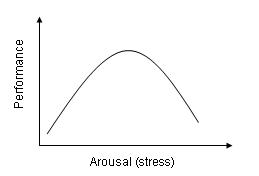
DescriptionHuman performance at any task varies with arousal in a predictable parabolic curve. At low arousal, people are lethargic and perform badly. As arousal increases, performance also increases - but only to a point, after which increasing arousal actually decreases performance.
DiscussionThe original research by Yerkes and Dodson was based on rats in mazes. There was one right way through the maze and wrong routes gave electric shocks. They were looking for the optimum punishment where the rats learned quickest. And indeed, as voltage increased, learning increased also But beyond a certain voltage, performance went down as rats started to slow down, freeze and retreat rather than risk more nasty jolts. They even started forgetting where was safe and where was dangerous. While unkind to rats, this showed how increasing stress only motivates until the point at which the stress, rather than the task, becomes the increasing focus of attention. Without some motivating tension we have no reason to act. In this way, stress can be thought of as a good thing. We are built to be motivated by stress so this often happens. Imagine if you were offered a huge sum for doing perfectly something you are good at. While normally you would perform the task well, the possible reward would weigh heavily on your mind, distracting you and increasing the likelihood that you would make a mistake. This happens to sports people when the pressure to win causes unforced errors. The problem is that too much stress results can cause performance to decline again, sometimes sharply if cognitive or nervous breakdown is triggered. A downturn can also be caused by excessive attention to a task such that extra factors that are important get missed. The behavior in the downturn has been called satisficing and is quite differently motivated from the earlier stages. Rather than gain satisfaction or reward from actions, the person who is is satisficing seeks any way of reducing their stress. This can lead to sub-optimal solutions being used, which accounts in part for the performance decline. So what?So when motivating people, find ways to increase their arousal level but only to the point where performance is maximized. Different people have different overload points so do be careful about this. See alsoThe Need for Arousal, Tension principle, Stress, Satisficing |
Site Menu |
|
| Home | Top | Quick Links | Settings | |
|
Main sections: | Disciplines | Techniques | Principles | Explanations | Theories | |
|
Other sections: | Blog! | Quotes | Guest articles | Analysis | Books | Help | |
|
More pages: | Contact | Caveat | About | Students | Webmasters | Awards | Guestbook | Feedback | Sitemap | Changes | |
|
Settings: | Computer layout | Mobile layout | Small font | Medium font | Large font | Translate | |
You can buy books here |
|
And the big |
|
| Home | Top | Menu | Quick Links | |
|
|
Site Menu |
|
| Home | Top | Quick Links | Settings | |
|
Main sections: | Disciplines | Techniques | Principles | Explanations | Theories | |
|
Other sections: | Blog! | Quotes | Guest articles | Analysis | Books | Help | |
|
More pages: | Contact | Caveat | About | Students | Webmasters | Awards | Guestbook | Feedback | Sitemap | Changes | |
|
Settings: | Computer layout | Mobile layout | Small font | Medium font | Large font | Translate | |
|
| Home | Top | Menu | Quick Links | |
|
|