How we change what others think, feel, believe and do
|
|
How we change what others think, feel, believe and do |
Diffusion Curve
Disciplines > Communication > Diffusion > Diffusion Curve Innovators | Early Adopters | Early Majority | Late Majority | Laggards | See also
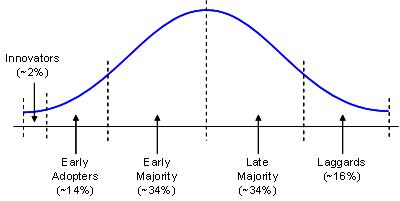
The diffusion curve shows the distribution across segments and approximate adoption over time of models.
AxesThe horizontal X-axis is time and the vertical Y-axis is numbers of people. The curve is idealized in that it assumes a Normal frequency distribution with the early majority and late majority one standard deviation either side of the mean. It is worth noting that not all innovators are innovators in all categories or situations. People who will buy the latest gadgets at home may be quite conservative in work (or vice versa). Thus a person who has the latest camera may have a car that is a few years old and be very conservative in their approach to religious ideology. SegmentsThe curve is divided into five sections, each of which may be used to describe a market segment, in that each group thinks differently and so needs different marketing and sales approaches:
Business changeThe diffusion curve is useful in business change as well as marketing. If you are implementing a new system, by understanding the different segments in the company, you can gradually roll out the change whilst using different persuasion methods for each group. See also
Rogers, E.M. (1962). Diffusion of Innovations. Glencoe: Free Press
|
Site Menu |
|
| Home | Top | Quick Links | Settings | |
|
Main sections: | Disciplines | Techniques | Principles | Explanations | Theories | |
|
Other sections: | Blog! | Quotes | Guest articles | Analysis | Books | Help | |
|
More pages: | Contact | Caveat | About | Students | Webmasters | Awards | Guestbook | Feedback | Sitemap | Changes | |
|
Settings: | Computer layout | Mobile layout | Small font | Medium font | Large font | Translate | |
You can buy books here |
|
And the big |
|
| Home | Top | Menu | Quick Links | |
|
|
Site Menu |
|
| Home | Top | Quick Links | Settings | |
|
Main sections: | Disciplines | Techniques | Principles | Explanations | Theories | |
|
Other sections: | Blog! | Quotes | Guest articles | Analysis | Books | Help | |
|
More pages: | Contact | Caveat | About | Students | Webmasters | Awards | Guestbook | Feedback | Sitemap | Changes | |
|
Settings: | Computer layout | Mobile layout | Small font | Medium font | Large font | Translate | |
|
| Home | Top | Menu | Quick Links | |
|
|